Recently, the U.S. government has been searching more and more electronic devices at the border. These include cell phones, tablets, and laptops. Generally, citizens are protected from searches like these, but the laws are weakened in the case of the U.S. borders. It is concerning to see this happening more frequently as personal electronic devices, especially cell phones, contain a very large amount of personal data on them. Also, you are unlikely to be able to deny the search and still reach your destination. You may be detained and questioned further if you do not allow the border agents to search your devices. They may request to search your device or ask for the password. They could even copy data off the device and store it for later investigations. This is a huge privacy violation and your should protect yourself from these searches. Bring as few personal electronic devices as possible when travelling through borders. Every device is subject to search. For the devices you do bring, remove as much personal data as possible. On your cell phone, you should offload pictures, documents, sign out of email accounts. Even consider factory resetting the device as long as you have it backed up. You could even consider keeping a second phone with no personal information in it for this sole purpose. There is not very much you can do to combat this right now besides the steps above. As mass surveillance becomes more prominent, we will have to find new and innovative ways to ensure it is not violating the rights of U.S. citizens.
The Challenges of Instructional Design
Being a job that involves collaborating and communicating with other designers and clients, Instructional Design has a vast potential for challenges. One of the most prominent challenges lies with communication between the client and designer. A common scenario is one such as this: the client wants something, so they hire a instructional designer to make their ideas into fruition. The client has some preconceptions how the process will go, what they want, and an image of how it will turn out. The developer listens to the needs, and (to the best of their ability) interprets what they are wanting, but making sure it aligns with producing the result the client wants. What occurs is the designer recognizing different practices that will achieve the client’s goal more effectively. The client will get perturbed by the change, and demand adjustments be made.
This relationship of the client and designer reflects theory versus experience; one is based in idealism with a great potential for innovation and perspective, while the other one understands what principle actually work in practical use. Thus, there needs to be a compromise between the two mindset. The designer’s challenge is learning how to listen well to the client’s needs, and interpreting what will get the job done while satisfying the client’s unique style.
Here are some other challenges faced in the development process of Instructional Design!
https://elearningindustry.com/top-10-instructional-design-challenges-in-elearning
Self Care and Social Media
Some folks argue how dangerous social media is, but with everything comes a positive and a negative.
The folks who run these pages, in my observation, want to reduce mental health stigmas and deconstruct the way we heal vs. how our society tells us we “should” heal. Using the platform of Instagram to tackle a social problem is a another way we are advancing in Social Media usage
With my insurance, when I had it, I had a patient portal that I could access from an App on my phone. There is a move for “Online Doctors” and a way to virtually be able to see and/or talk to a physician. Mental health focused social media accounts are a piece to that pie we will finish baking in the near future.
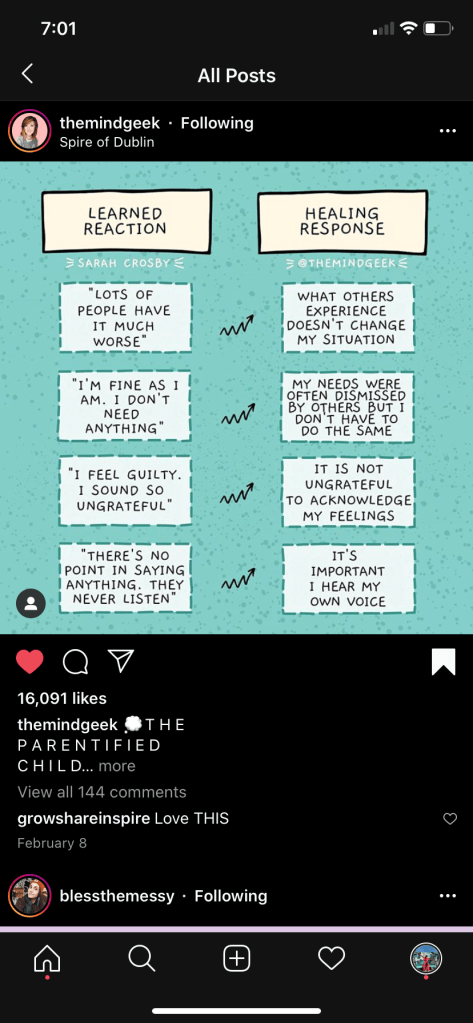
These Instagram pages are the closest thing to therapy most folks (including myself) will get because of how much harder therapy is to access than a free app on your phone. Pages like these are sometimes tailored to certain professions and if you’re an activist, you’re going to need to follow one, if not multiple therapy accounts.
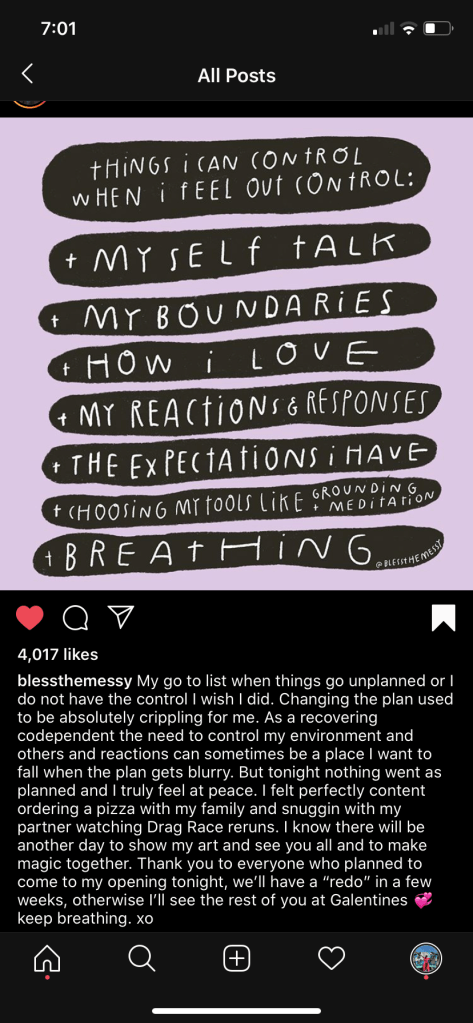
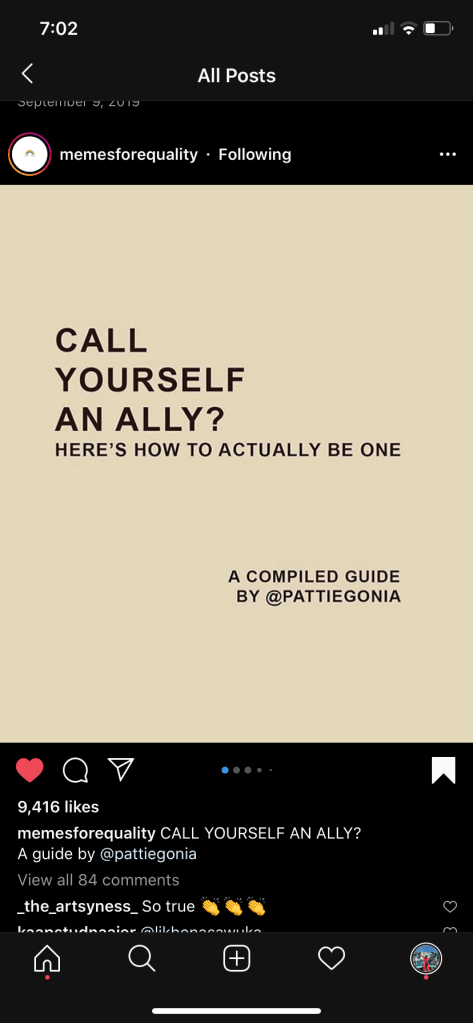
This page, as hinted by the name, is tackling the social problem of inequality through Instagram. They give you tips, tricks, and educational resources that affirm equality and equity, and denounce bigotry. They do not “cancel” folks through Instagram. Instead, they provide you with resources on how to do better, as pictured below. I have not looked through their comments and I do not have information on if they educate folks through the comments as well, but with a whopping 184K followers, I doubt there’d be much comment interaction.
Elon Musk calls for better AI regulation for everyone.
In response to an article regarding OpenAI by MIT Technology Review, Elon Musk claims that there needs to be better and more defined regulation regarding the development of advanced AI. OpenAI is a company that is working towards building safe AI that is beneficial to all of humanity, with big-name investors such as Microsoft and Khosla Ventures. Musk isn’t new to the idea of challenging AI, previously labeling the technology ‘more dangerous than nukes.’ Elon Musk works with AI himself and his company, being no stranger to the capabilities the technology provides both now and later on down the road. What Musk advocates for, namely, is a public body with insight over the development of AI to ensure its maximum possible safety.
Even Our Televisions Can Spy!
Do you want to watch Netflix on your TV screen? You need a smart TV. Do you want to be able to access Amazon Prime Video on your TV? You need a smart TV. Do you want to play Spotify through your TV? You need a smart TV. Smart TVs are becoming very popular in every household, as we want to keep up with the latest streaming trends. The issue that we do not realize is that even our television sets have a way of accessing numerous amounts of information. Most smart televisions come with an ACR setting that stands for Automatic Content Recognition. With this feature being installed our television basically watches what we watch and can sell our information to advertisers. ACR may not seem that terrible but there are also other issues with smart televisions. According to LifeWire, the voice controls and cameras installed on our smart televisions that allow us to change channels, play videos games, and even video chat can be hacked and may act as a “surveillance” camera. Scary right. Life Wire suggests that the best way to protect yourself is to cover your televisions camera when not using it, use strong security on your router, update the operating system regularly, and add the most restrictive options when setting up the television. With the amount of streaming services being introduced and all the advanced technologies, smart televisions are not going anywhere. In fact, I believe they are going to be more popular. We just need to know what measures to take to make sure we are as safe as possible, and to make sure our televisions are not spying on us.
https://www.lifewire.com/what-you-need-to-know-about-smart-tv-security-4768087
Social Media, Echo Chambers, and Polarization
An echo chamber is defined as “an environment in which a person encounters only beliefs or opinions that coincide with their own, so that their existing views are reinforced and alternative ideas are not considered.” This type of environment is never more prevalent than when on social media. To examine echo chambers in real time, Laura Jakli from Stanford University conducted a study where she and her team looked at 40,000 Twitter users and sorted theme based on their political views. As it turns out, when a controversial topic came up, there was a shocking lack of moderate viewpoints.
Usage of hashtags, suggested accounts to follow, and the conversations you take part in all factor into what comes up on your social media feed, be it Facebook or Twitter. Studies show that when politically active on social media, you tend to be grouped with those who share your ideas and political slants. To learn more about this topic overall, check out these articles on The California Report and Vox.
https://www.kqed.org/news/11703717/how-social-media-echo-chambers-drown-out-the-voices-in-the-middle
TikTok Under Fire for Censoring Transgender Users
https://www.bbc.com/news/technology-51474114
TikTok, the popular short-form video platform, is in trouble again this month for reportedly removing the videos of many transgender users. While TikTok claims that some videos were removed due to depictions of smoking and nudity, TikTok has offered no explanation as to why other less controversial posts have been removed from the platform. As a result, many members of the trans community who use the app, and the LGBT charity Stonewall, have openly criticized TikTok for this censorship.
Personally, I find this news very disappointing. Many members of the LGBTQ+ community use platforms like TikTok as a safe and reliable platform to express themselves, their journeys, and their opinions. It’s sad to see such a popular platform like TikTok who claims they are “…proud to be a platform for positive and creative expression for our diverse community of users” censoring videos of trans people. What’s worse is that TikTok can’t even explain why the videos are being deleted. Is TikTok’s super sensitive censorship algorithm to blame for this? Could it be that TikTok is purposely deleting these videos, but they don’t want to admit it as to not come off as transphobic? If TikTok becomes deemed no longer a safe and reliable space for members of the LGBTQ+ community to express themselves and feel represented, what other platforms will be left for them to use? I really hope that TikTok starts to do a better job soon at making the trans community and the LGBTQ+ community feel safe and uncensored.
India’s new privacy bill
This bill will allow the government to demand social media platforms to reveal user identities without a warrant. This has been proposed by India’s Ministry of Electronics and Information Technology who is expected to publish it later this month. The controversial bill was proposed by the government in December of 2018 and has since received a lot of backlash from the public. This is not happening in the U.S, but how do you feel about this controversial topic? Would you be fine if it were to pass in the U.S?
Indias History with blackouts
India has a long history with blackouts, however, the one that occurred in 2012 is by far the worst and longest lasting. It affected 650 million people and lasted for 2 days.
https://www.wri.org/blog/2012/08/india-s-blackouts-highlight-need-electricity-governance-reform
We Are More Vulnerable Than Ever!
Being connected to the internet at all times seems great. We can control the lights in our house with our voice, we can talk to people through are car, we can play music through Bluetooth devices around our house, and much more. With technology and voice controls being everywhere we go, it can make our life easier but also leaves more room for our information to be hacked. The “Internet of Things” has been found to collect a staggering amount of data which leaves a large amount of information accessible to hacker, and hackers can invade your home through smart devices. According, to Bushiness Insider only 10 percent of enterprises feel as though their devices could stand the time against hackers. With the amount of information we have out in the world all businesses should be 100 percent sure that their devices could stand up to hackers. With all that being said, just be careful what information you have out in the world, and how many devices you are connected to. Make sure you have every privacy control on you possibly could, and do your best to be aware of possible hackers.
 LIS 4022 Spring 2020